Reactor fault simulations show when to act, wait or seek an independent measurement.
Different reactor faults can produce almost identical instrument readings. This simulation creates those hidden failures, keeps the true cause known and tests which new evidence can tell them apart.
Watch the simulation ↓Test which additional evidence distinguishes reactor faults that produce nearly identical instrument readings.
A simulation that generates diagnostic challenges with known hidden causes. It uses a simplified reactor model. No real plant, trained AI diagnostic system or human operator was evaluated.
Explore the recorded comparison
Load changes help some fault pairs; others need time or independent calibration.
Replay instrument readings to compare a load change with an equally long wait, and see which cases need independent calibration.
Loading the reviewed dataset…
Explore the results Experiment settings, comparisons and evidence
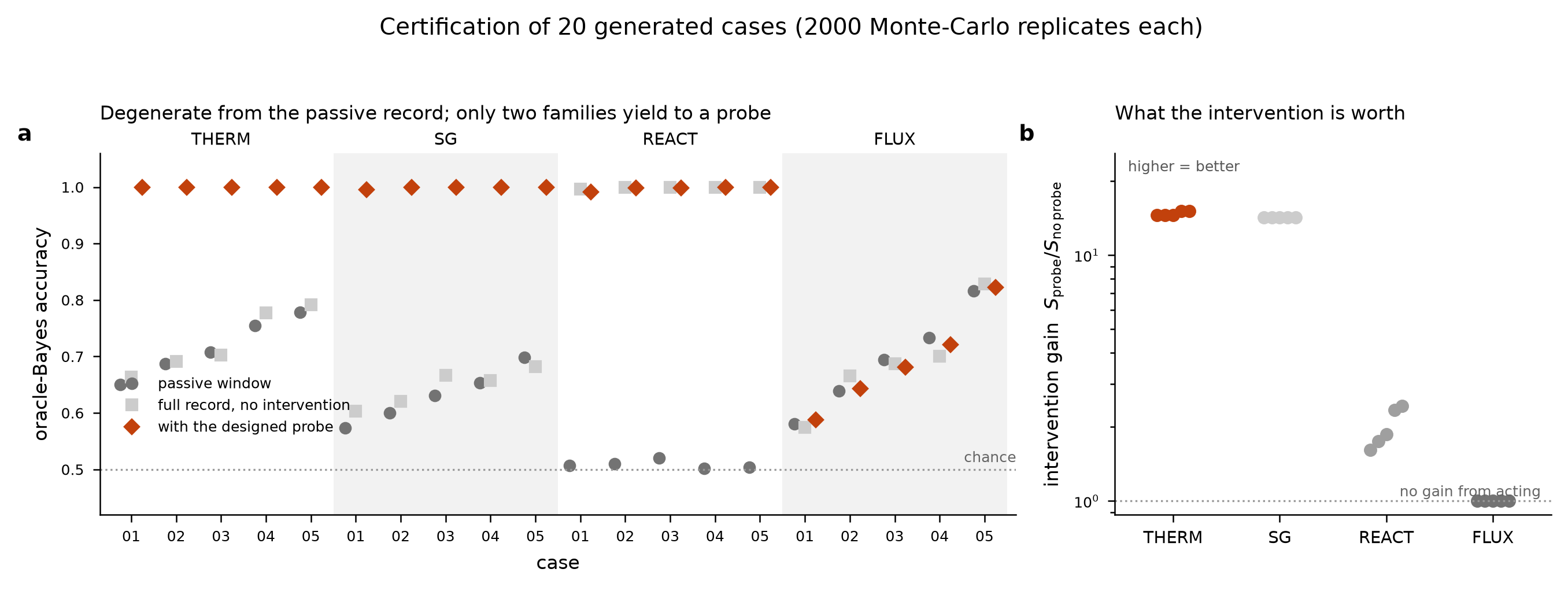
All 20 scenarios remain visible, including four that do not meet the source’s strict similarity requirement. Each animation is one generated record with random sensor noise. The two hidden explanations and the waiting alternative are not separate clean traces in this replay.
Simulation campaign
We compared simulated interventions with equally long observation.
The simulation starts with two physical explanations and preserves which one is true. It accounts for imperfect instruments, searches possible experiments and checks the result against waiting for the same length of time.
Different plant and instrument faults produce similar readings.
Change a physical plant property or an instrument setting, then find a different fault that matches its key reading. The sensor traces come from the resulting reactor behavior, not from editing a finished signal.
Physical fault definitions and matched observationsInstrument uncertainty limits which differences count as evidence.
Allow plausible calibration errors, slow drift and uncertainty in response size. A diagnosis should not depend on tiny differences that the instruments or simplified model cannot predict reliably.
Instrument assumptions and uncertainty treatmentCandidate actions are searched within the model’s operating limits.
Vary the type, strength and duration of a simulated action. Reject a choice if any competing explanation would cross the model’s limits. Keep the alternatives so the selected experiment can be compared with them.
Bounded search across five action typesEqual-duration waits test whether the action adds useful evidence.
Compare the chosen experiment with an equally long observation record without it. Repeat the diagnostic check with random sensor errors, keeping the statistical separation calculation distinct from the observed classification results.
Equal-duration comparison and repeated noisy testsSee the scale and model detail +
Sixteen pairs meet the source’s similarity threshold. Four larger-fault boundary examples remain visible instead of being discarded.
The supplied simulation tests 72 action choices for each of 20 scenarios. These are modeled comparisons, not experiments performed on a real reactor.
For temperature and steam-generator ambiguities, this measures how distinguishable the causes become after allowing for instrument uncertainty, compared with waiting just as long. It is not a multiplier of diagnostic accuracy.
The reactor model tracks 20 changing physical quantities and seven instrument readings. It includes power, heat transfer, cooling, fuel-related chemical changes and automatic control. The source supplies 15 mathematical reference comparisons and repeated diagnostic tests with random sensor errors. These calculations were not independently rerun. One important check disagrees with the source’s accuracy formula and remains unresolved.
The outcome
Load changes separate some faults; other cases favor waiting or independent calibration.
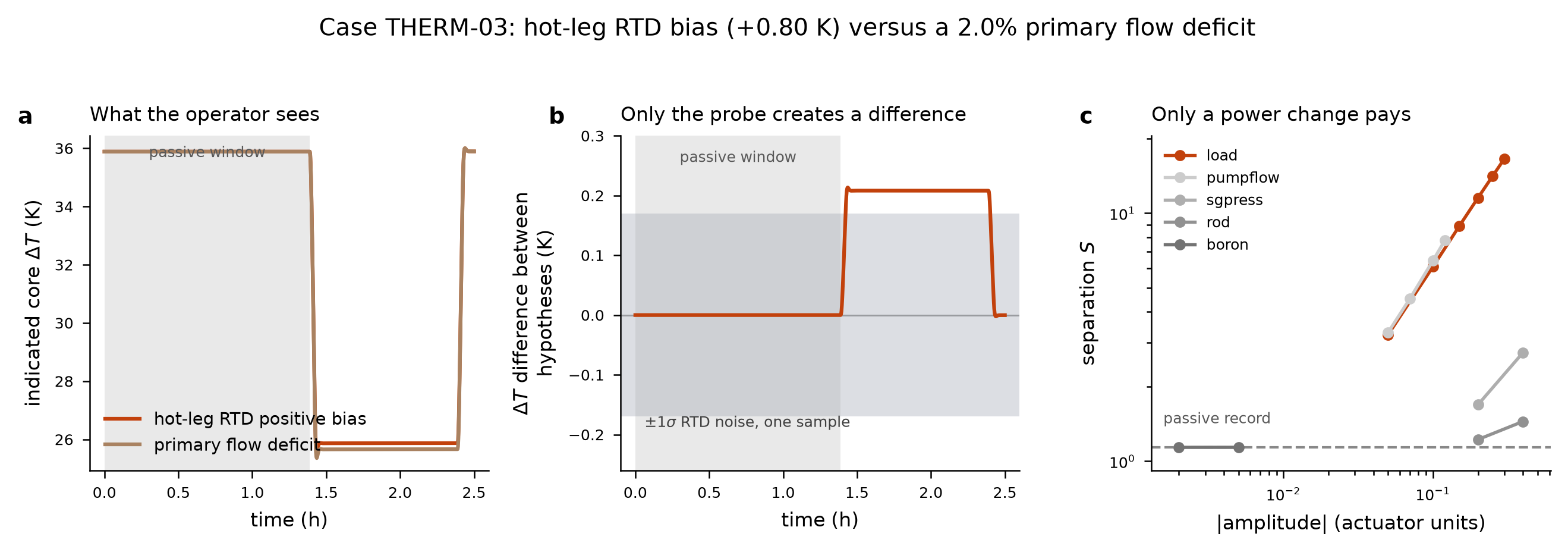
Changing load helps distinguish temperature-measurement errors from cooling problems, and helps distinguish steam-generator problems from misleading readings. For slowly changing reactor conditions, waiting already identifies the cause in the reported tests. For two calibration errors, the available physical actions add no distinguishing information.
Load changes separate instrument errors from modeled plant losses.
A fixed instrument error does not change with power in the same way as a physical plant loss. The selected experiments make these causes much easier to separate. Reported identification accuracy is 99.5–100% within those simulated tests.
Longer observation already identifies slow-change faults in the reported tests.
Two causes of a slow reactor change follow different paths over time. An equally long wait already gives 99.6–100% identification accuracy in the reported tests. Crediting the experiment alone would miss the contribution of time.
Calibration errors remain indistinguishable under the available actions.
Two miscalibrated instruments can imply different diagnoses while the physical reactor behaves identically. Every available experiment adds no distinguishing information. An independent calibration measurement is the missing kind of evidence.
Equal-duration comparison
Waiting already explains the diagnostic gain in slow-change scenarios.
Result after a load changeA strong diagnostic result after changing power made the slowly changing reactor scenarios look like successful experiments.
Result after an equal-duration waitWaiting for the same length of time already identifies those causes in the reported tests. The source’s final interpretation is to keep observing rather than attribute the result to the maneuver.
A separate validation problem remains: in one initial-observation check, the formula predicts 70.2% accuracy while repeated simulated tests achieve about 52.0%. The page keeps both measures separate instead of claiming that the mathematical accuracy guarantee was validated.
Implication for diagnostic evaluation
Diagnostic evaluation must test which evidence a system requests.
Recognizing a fault is only part of diagnosis. A system also needs to recognize ambiguity, choose an informative experiment and know when acting will not help. Simulated scenarios with known hidden causes make those abilities testable without pretending the current readings settle every question.
Known-cause fault pairs make evidence selection testable
A working simulation process creates hidden faults, preserves their true causes, searches revealing experiments and compares them with waiting. It supplies diagnostic challenges and exposes a validation issue that still needs explanation.
Real-plant diagnosis is untested, and an accuracy-formula discrepancy remains unresolved
- The reactor is simplified and is not calibrated to a particular plant. It omits spatial detail, simultaneous faults and heat from radioactive decay, and simplifies the steam system.
- Instrument uncertainty and operating limits are assumptions. The automatic controller also responds to very small errors that a real controller may ignore.
- For the slowly changing reactor scenarios, formula-based accuracy predictions disagree materially with the repeated noisy tests. A general validated mathematical accuracy guarantee is not established.
- Perfect identification in a finite set of simulated tests is not guaranteed real-world accuracy. Only sixteen of the twenty fault pairs meet the source’s similarity criterion.
- A steady chemical change and a steady control-rod movement can remain indistinguishable under every available action. Additional evidence outside the current sensor set is needed.
- No trained AI system, deployed diagnostic tool or operator was tested. How difficult these challenges are for such systems remains unmeasured.
The evidence
The original figures compare designed experiments with waiting.
Unaltered supplied figures, with the model scope and final corrections kept beside them.
Read the source and interpretation notes +
Download the reviewed evidence notes ↓ · Download the displayed data ↓
Related simulations
Related simulations compare robotic fingers and utility response strategies.
Robotics · touch and control
Robotic finger design simulation
Simulate robotic fingers before fabrication. Compare skins, touch sensors and controllers across manipulation tasks.
Explore the simulationEnergy · connected-system resilience
Large-scale cyberattack simulation
Simulate cyber disruption and physical failures at a fictional energy company. Compare how defensive responses affect electricity delivery and business operations.
Explore the simulation